Up until recently, I’ve been a pretty contented single woman, gracefully accepting (at times embracing) my aloneness. Even coming to terms with, what seemed at the time, a strong possibility that I will not have children (see Gateway Women). Though I didn’t suffer a brooding phase, I felt a woman without children is a big deal, and possibly even a bigger deal in developing regions like the Middle East, where a girl only becomes a woman once she is a mother, and a boy a man when fatherhood beckons. Before children, Marriage in Islam, and other monotheistic religions (Marriage in Christianity and Judaism), views a mate as a kind of completion of the self. I am somehow incomplete without my spouse.
Often, I found those around me struggling to accept my state of being more than I was, as if my contentment was a threat to a societal norm: a woman needs a man like a fish needs a bicycle, and all that! Unless those around me were chosen friends who were incredibly inspiring older women I look up to, and who have come to a realisation that convention need not be for all.
Besides, women who are not biological mothers, I’ve found to more readily take the role of Mother to those around them. Rather than focus attention on what I’ve sprouted, I attend to those I love and care for. This goes against another assumption that those without children or/ and partners are more selfish. To me, those without are more inclusive to those around them, whereas those with immediate responsibilities (understandably) prioritise their own.
I write this as I notice my former aloneness invited limited moments of loneliness, as I did exactly what I wanted, whether to make myself an omelette at midnight or hop on my bicycle at 4:30am to dance at a morning rave. Today, as a recently wed woman, I feel more susceptible to bouts of loneliness. This is partly because my partner is working abroad and I’m unable to join him until next month, and also because a life intended for two can be a lonelier place than an independent life open to one and all.
Conventionally, marriage implies being more settled somehow, whereas admittedly my experience of marriage so far has been anything but settling (with travel and a planned home move ahead!). And yet, the inner peace and settlement, which for me comes and goes, remains unsteady in a newly forming relationship. This invites vulnerability, which I’ve always struggled with, and I imagine many others used to an independent life.
Alone, I was able to fend for myself, knowing what I want and who I am. Today, the reality of who I am is reforming, remoulding to fit alongside my partner’s reality, who (in his own way) is going through a similar process. Admittedly, we both found comfort in returning to our old/ pre-marital routines, whether to grab a burrito for breakfast or vegging in front of the TV. At the same time, because I’m now married and meant to be one of two, I feel lonely when alone. As a contented single woman in my thirties, I felt more a like a fighter of convention or a butterfly fluttering to where I please. Today, well, I’m not sure yet.
So, to the unconventionally contented single women out there- my former self included!- I salute and honour you. And to the less contented single ladies, and gents, looking for their ‘other half’, then I promise you, the journey and struggles do not end with a loving partnership; it just broadens to embrace more of the Unknown. Celebrate your independence, freedom and world-facing openness, before your attention is channelled towards one other.
And if that ‘one other’ calls, and you feel the pangs of love in your soul, then embrace the vulnerability and loneliness as vital ingredients on the journey of coupledom, and I hope, transformation into something altogether different.

Since last July, I’ve felt stretched between life and death; in love with a man, whom I have since married, and working daily with Iraq Body Count (IBC) within the theme of death.
Before working with IBC, my knowledge of this not-for-profit organisation was limited to their function, namely, recording casualties of war and current violence in Iraq from 2003 until the present day. What I saw was a dry database with records of violent incidents and respective number of dead, maybe with a handful of demographics facts (names being a rarity!). Unaware of their vision or their story, I somehow dehumanised an organisation that aimed to humanise the ever increasing death toll in Iraq. These were originally British citizens who disagreed with their country’s decision to take military action in Iraq, who felt responsible and yet helpless. IBC was created, by volunteers, to calculate the human cost of war, to make a statement: the figures you hear about in the media, are people with lives and loves and hopes and dreams.
The name alone is designed to provoke, and it often does, especially at Israeli security checks, as I learned a few days ago: ‘is this organisation political?’, I was asked, ‘well’, I hesitated, ‘only in a human rights kind of way…’. My husband and I waited for several hours at the Jordanian-Israeli border crossing after that.
My past trips to Lebanon, Syria, the UAE and Yemen did not help our case. My husband’s biggest bugbear (and source of much pride) has little to do with what he has done, but rather, what he happens to be: a Palestinian.
Rather than striking fear and victimhood into our minds and hearts, such countries may also have much to offer by means of human stories of survival, daily narratives from those who have gone through extraordinary circumstances, who deserve to be heard and potentially allow us to learn something for ourselves.
This is the idea behind Iraq Digital Memorial, an initiative from IBC, namely: to humanise the numbers compiled in the IBC database and those listed in media reports, and to invite Iraqis themselves to create a memorial for their family and friends. Individual profile pages of those who have died, with photographs, music clips, description of who he or she were, and how their family and friends continue to remember them today.
‘Remember this is a 6 month job contract!’, a concerned friend and mentor warned me back in August, when he sensed my enthusiasm and longterm planning on the memorial.
IBC is twelve years old. Like an adolescence on the cusp of adulthood, they are transitioning from a basic function: a clear aim of documenting deaths with questions of accountability; to moving into a richer process of honouring the memory of those who have died, as well as finding a way of recognising those who survive (possibly thrive) and continue to live.
My post with IBC may have an end point, though Iraq Digital Memorial is a longterm initiative, especially as the intention is to design an interface based on human-to-human meetings, with Iraqis who have lost friends and family, whose different grieving processes is taken into account.
I’ve met with Iraqis who have lost family and friends, as well as those who haven’t, but whose opinion seemed relevant and important to include. The last participant I met with was one such example; a young US-born Iraqi activist, who has been documenting various grassroots civil society initiatives in and outside Iraq. Initially, discussing death seemed, to him, somewhat contradictory to his mission of highlighting inspirational stories of hope towards a better future of Iraqis. A memorial seemed an unhelpful reminder of pain most Iraqis wanted to escape. And yet, acknowledging death, being real with what is, we are potentially better able to embrace life more fully, to move truthfully from ending to beginning.
Marrying someone I did not know this time last year has left me with my fare share of beginnings, and a part of me was (and continues to be) eager to ignore endings and to look forward, not back.
Then, I believe: whatever issue (or knot) I refuse to acknowledge, I inevitably pass on to those around me, in some form or another. From odd coping mechanisms, which alienate those I live with, to cycles of violence [LINK TO SCILLA] that ensure our future is locked into our past. This works on a collective level too, if a group of people (a generation, particular community or family) choose to avoid, then the wounds are passed on (see transgenerational trauma and Epigenetics).
Speaking of his personal experience, I heard my partner say: ‘Heartbreak can be worse than death’. Yet, he chose to face his pain and work with it, and by ‘it’ I of course mean, with himself, namely this wounded part that needed attending to. I can only avoid and ignore my own experience/s by essentially, in some way, dismissing myself.
This can also relate to life perspectives: I may choose to see the end of a relationship as living proof that romantic love is doomed to fail, as I had chosen to do for years (largely without my own awareness); or we can work to heal ourselves, muddle and struggle to reconnect with the world around us, and transition towards new possibilities. This is what he chose to do.
Grieving is a unique process, without rules of right and wrong.
In relation to literal death and the people I met, who courageously shared their experiences of losing a loved one to violence, well, they dealt as best they could with the resources they had/have at hand. And the latter often was considerably more than anything available to Iraqis inside Iraq, as physical safety was a constant factor for those living in the UK and US. Therefore, as well as acknowledging individual deaths and survival experiences, Iraq Digital Memorial also aims to be a collective place of sharing and connecting. As a mother who has lost a son or daughter, I may be able to learn of other mother’s experiences, learn from her responses and perhaps share some of what I found helpful in my own process. An online support network, which digitally connects Iraqis, inside and outside Iraq, with the wider world.
All this is in theory, as the memorial currently consists of a vision, a collection of opinions from potential participants and a design waiting to be mapped out. IBC is in it for the long haul.
As for me, I continue to find much of my own life experiences- some relating to endings, some beginnings- unearthed into the present, as my partner and I travel through our respective homes. From San Francisco to London, Dubai to Beirut, Amman and Ramallah, and back again. None are Home, and all are homes with family we love.
I wish I can take him to my home in Baghdad, which my family no longer own. Even if they did, I would not risk his life. I am proud of the Iraqis I have met over the last five months or so, and look forward to their sharing some of their stories with you.
Watch this space.
Though don’t hold your breath.

When a friend forwarded Outreach Worker at IBC a few months ago, I thought: An important project, though maybe too miserable for me to take on?
Then I wondered: Why do we need to honour the dead?
Spiritual and religious reasons aside, I don’t believe the dead need honouring, commemorating or even remembering. The living do, as we search for a way to honour our memory of a loved one who is no longer with us in body. When their life ends, I would want to find a sense of completion, and possibly peace, to continue living mine as best I could.
Though in the context of violent conflict, as the case is with Iraq and sadly much of the Middle East now, how can I find peace when so many are losing their lives at an astonishing rate?
I came across Iraq Body Count website (IBC) when it was first set-up in 2003, by volunteers in the UK. I remember logging on to their database, with a daily recording of lives lost to violence, and saw named incidents, and mostly, numbers of recorded dead. In 2003, I was too emotional with the war, and inwardly conflicted, as my adopted county of citizenship, the United Kingdom, lead a war on my country of origin, Iraq. I couldn’t relate to the lists of the dead, and didn’t want to. It was too painful a reality to face.
Revisiting the site, in preparation for the job post, the only question that kept coming up for me, as I saw entries like ’17 dead in Mosul, suicide bombing’, was ‘and then what..?’. How can I relate to this information? Who is the person behind the death?
To explore the living survivors of lives lost.
Applying for the post, I decided that, if offered the job, I’d only take it if I was able to explore the living survivors of lives lost; the psychotherapeutic resilience entailed in carrying on with the business of life, when my son or best friend are killed suddenly and senselessly.
Having taken the job of Outreach Worker for IBC, I am now asking: are Iraqis, inside and outside Iraq, starting at home with UK Iraqi diaspora, ready to begin to face the pain of those lost to violence? If yes, how do we want to do this? How can we, as war continues today?
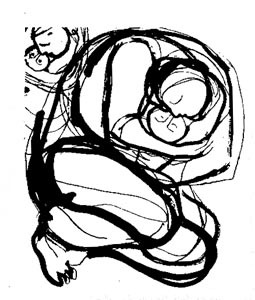
By Iraqi artist, Jawad Saleem (1919- 1961).
Iraq Digital Memorial is a potential future, online record of the dead, as remembered by those living who knew them. It’s a simple concept: if I have lost a friend or relative in 2003-onwards, I log on, get authenticated, and share what I knew about this person. This sharing would be in two parts: factual demographic information, like their name, age, profession. Then the second part, is to include short stories, personal narratives, of the deceased; what do I remember of them? What were they like? What reminds me of them today?
The second, personal part is what I’m more familiar with, though the importance and relevance of the latter (IBC’s bread and butter!) only hit me when I was chatting to family a few weeks ago, namely, my stepmother.
She related how, in 2003, she and my father escaped the imminent 2003 war, to stay with my brother in the UAE. And how, her mother, in Baghdad, took it upon herself to check on their pet cat, Simsim, and golden labrador, Lucky. Her mother, without much thought, drove towards my parents’ home, and upon exiting an underground tunnel, found herself face-to-face with a US tank.
Now, as far as I’ve understood, under Saddam’s regime, Iraqi citizens were cut off from the internet and world media to the extend that many were unaware that war had broken out (!). There was no moving public announcement, such as the one
British Prime minister Chamberlain made on the eve of the World War II in September 1939. The more privileged, like my parents, knew and made decisions accordingly, for example, some with children or elderly chose to stay put in the hope the war would be short lived. Witnesses spoke of US army tanks, on Baghdadi streets in March 2003, shooting all who roamed the streets, meant that many civilians killed had truly been innocents going about their daily routine, suddenly struck dead.
My step-grandmother (is that a term?) wasn’t shot, possibly (my stepmother believes) because she was driving my father’s olive green, American jeep. She tore her white underskirt, and came out waving it as a flag of surrender towards the soldiers. She was promptly sent home, shaken though otherwise alive and well.
My stepmother cried as she recalled her brother, who lost two of his best friends to US military tank firings that same week, angrily accused her of risking their mother’s life: ‘she would have died because of your stupid animals!’.
‘The truth is’, my stepmom said, as she wiped her nose, in a busy London cafe, ‘she wouldn’t have died because of our pets, but because she’d have been shot by a military tank!’.
This, to me, is why the factual side of casualty recording is so imperative: my death is recorded with the hard truth of who I am and how I died, regardless of how others make sense of my death, how I am remembered by those who knew me and what follows after my death.
The combination of such facts, juxtaposed by the personal narratives, the oral history otherwise forgotten, is what makes this initiative so unique and potentially powerful.
“We are not ready, we will never be ready, but this is important to do now…”
Another British-Iraqi participant, when asked if we are ready to begin commemorating our dead, said: We are not ready, we will never be ready, but this is important to do now, before we choose to forget or obscure the truth beyond recognition.
The ‘digital’ aspect means that unlike physical memorials, it is as alive and flexible as the living, and can potentially act as a pausing reminder of those who are lost to a rapid, ceaseless conflict. Particularly as the information, both factual and personal, would be directly uploaded by those who personally knew the dead, this could also be a reflective and healing process in itself. What and how I choose to share publicly, with the world as my witness, can help find this sense of completion in myself.
At a talk on ‘The Cycle of Violence’ by peace activist, Scilla Elsworthy, she spoke of how anger and vengeance only breeds more anger and vengeance, and how we need to step back and begin a process of reconciliation, which comes in many forms. I rarely pluck up the courage to speak in public events, though I found myself asking, if we can begin to heal from the traumas of violence when war was ongoing, as the case is with Iraq. She didn’t flinch, and sincerely replied: ‘yes, you lay the ground and sow the seeds, to begin a longer term healing process’.
“Everything is impermanent, even war. It will end some day.”
In the least, as people reflect on how they may want to share- or not share, as the case may be- their awareness of their suffering invites mindfulness, which paradoxically, allows them to be present with their suffering without being overwhelmed by it. The Zen Buddhist monk, Thich Nhat Hanh, recalls living in Vietnam during the war, which seemed never-ending and ever consuming at the time. When people asked him if he thought war would end, he struggled as he couldn’t see an end in sight. But he knew if he said, ‘I don’t know’, that would only diminish the little hope they were searching for, so he replied: “Everything is impermanent, even war. It will end some day.”
I hold onto this statement with Iraq in mind. We need to begin sowing the seeds of a peace my generation is unlikely to see, though I truly believe will come in time.
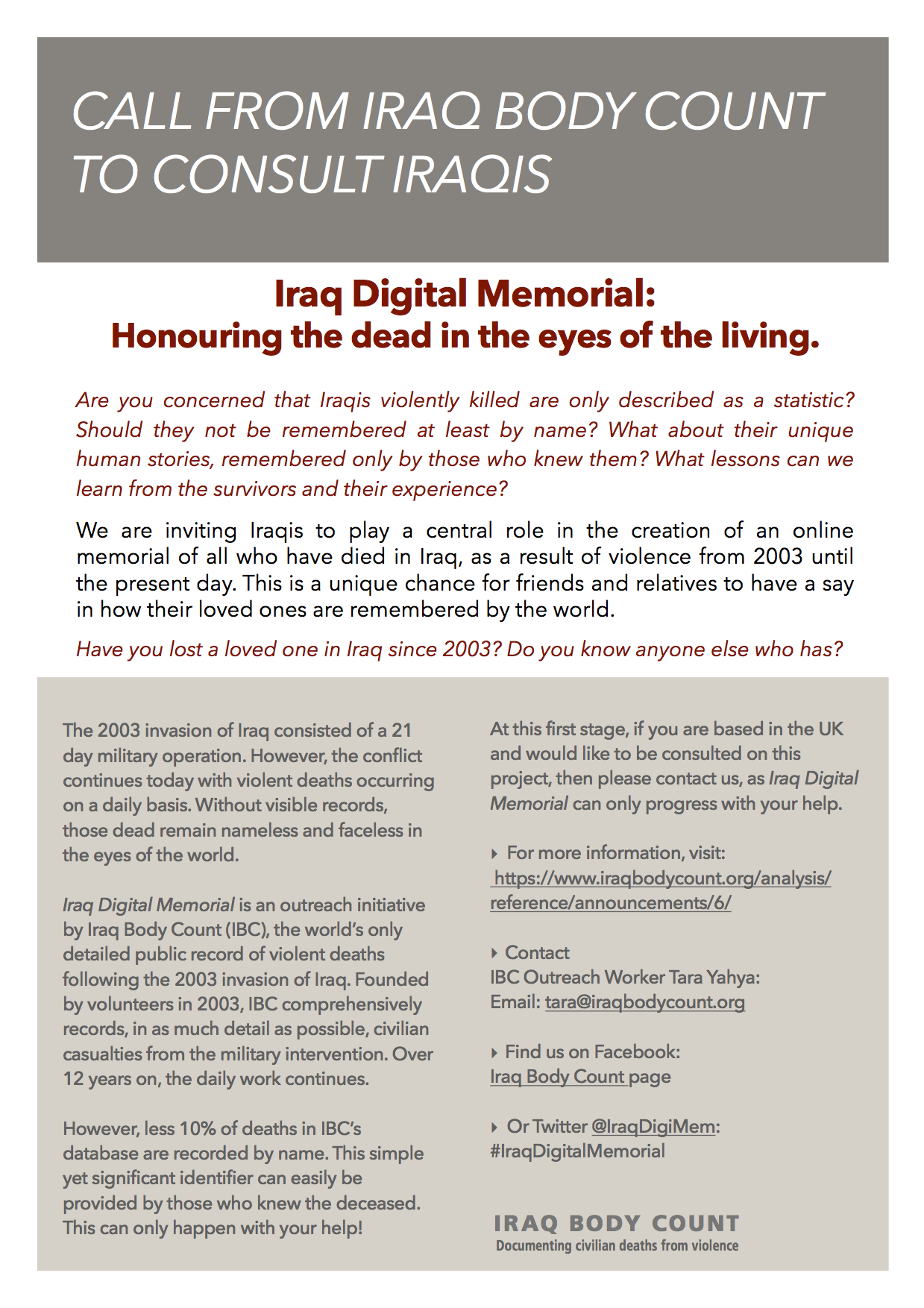
Call to Action: Arabic translation to follow!


I’ve been working with diaspora communities in the UK since 2010, and remain fascinated with how these function as a network; connected to one another, their current place of residence, country of origin and often to a much wider global community. How do communities achieve this, and why are some more successful than others?
My first exposure was to diaspora Armenians in Iraq, as with the rest of the Middle East, experiencing individuals and families with a strong sense of duty to the country they reside in, often having provided them refuge from persecution (see Armenian genocide), and unquestionable loyalty to their own people and beloved Armenia. My family have always had a ‘culture crush’ on Armenians (my opposite to ‘culture clash’!), praising Armenians in Lebanon for remaining neutral in the Lebanese civil war. Though the latter is debatable, as with all the below, my point is the balance of identity, between loyalty to past seeds and nurturing of current roots.
I then think of Palestinian diaspora, spread all over the world since the first exodus in 1948. I am still astounded to meet third and forth generation Palestinians, all steadily fleeing their homes and all united in knowing their Palestinian identity. This is not questionable. I recently met a young third generation man, who shared his family story, told to him as a child by his grandmother. She stroked his hair, with his head on her lap, recounting how Israeli authorities requested his grandparents, a young couple with a newborn at the time, to vacate the house for an hour as part of routine checks, only to return to an occupied home, stripped off its contents. In that instance, they were homeless, denied their Right of Return. To this day his gran carries the key to her old front door, hidden against her left breast, inside her brassiere. This is a familiar (near cliche) Palestinian narrative, with countless variations, and importantly, a red thread uniting a people to a dream, a vision, intention, a clear future plan that keeps a global community moving forward. My Palestinian motto: I have been pushed, and I will rise again and again, because I know who I am and I know who you are. I’ve always found Palestinian social events a world above other Arab ones, in organisation, originality and turnout. These tend to be widely publicised and well-supported by a far reaching and living network.
And who more diverse than the Jewish diaspora. Let’s zoom into a small cross section of young British Jews. Youth networks link young Jewish Brits to a sense of identity fundamentally tied in with the creation and existence of Israel. This may begin with a bar/bat mitzvah party, youth groups to gap year activities, including stints with the Israeli army (why not, eh?!). This loyal support often continues into adulthood, from major political and financial aid, to smaller local community initiatives. I would be first and foremost Jewish then, secondary to that, any other identifiers I may also belong to. A somewhat inbred loyalty, where any questioning of Israel or Israeli policies is depicted as a personal and collective threat to Jewish people as a whole. If the Palestinian statement is ‘I am a survivor’ then the Jewish one is ‘I am a victim’ (a fine line). The chosen people, envied and persecuted throughout human history, in the most inhumane ways imaginable, will (possibly rightly) never allow the world to forget. I recall a young Israeli playwright speaking of his frustration with, what he felt was a morbid industry of remembering wounding narratives (he’s not alone, see Holocaust Memorial Day in Israel).
There’s out-and-out resentment expressed for all three communities above. These ‘narratives’ can be seen as indoctrinations, ‘sense of community’ as insular, separate and potentially threatening to the whole, which in a way, they are. Speaking of threats, I wouldn’t go into the mess of ‘the British-Muslim community’, which strikes me as a network mobilised with fear and petrified in doctrine.
I am in awe of how all three named examples have managed to hold onto a collective identity that binds them across the world, be this ethnic or/ and religious. I am particularly struck as a British-Iraqi, whose global Iraqi diaspora are (arguably) by far more diverse than all three above communities put together, and yet there’s no ‘community’ to speak of. No global network for the whole. Instead, the whole is diminished by the divisive nature of its parts, as each ‘community’ sticks to its own bubble, with some religious examples: Jewish, Catholic, Orthodox Christian, Sunni Muslim this, Shi’i that, Mandean, devout atheists and communists (arguably, religions themselves)…
I don’t have answers and am aware of my generalisations, though I’ll be grappling with this, particularly in relation to Iraqi Diaspora communities, with a new and challenging Community Outreach post I’ve recently taken on. More on that later.
Do share your responses to the above- any thoughts, insights and objections- and let’s actively chew on this together…
Last weekend, I was invited to present at a conference in Sardinia on Sacred Landscapes. This was part of European Culture Expressed in Sacred Landscapes (ECSLAND), which invited a range of academics with a multitude of disciplines from ecologists, archaeologists, landscape designers to priests and artists (I fell under this category). I chose to look at how songs, as a musical and ritual form, have the capacity to link us to sacred spaces through the memories they contain. A song carries information- melody and words as well as whatever is evoked in the listener- allowing us to preserve our ties to a place, acting as ‘guardians of our cultural heritage’, as Laura, an archaeologist at the conference aptly put it.
I shared three different notions of sacred spaces, represented by music, and all linked to the Middle East: The Invisible Home, as migrant communities leave their original homeland they can carry music along with them (I sang an Arabic and a Ladino song from Andalusian Spain, from Arab and Jewish communities respectively); The Physical Home, using a more Christian notion of monumental landscape, as explained by Jala Makhzoumi‘s talk at the conference (here, I sang an extract of Fairuz’s iconic song Jerusalem, which mentions the churches and mosques alike); and finally, The Inner Sacred, looking at the Sufi Islam’s belief that God is ultimately in our hearts, if we choose to listen to Him/ ourselves (singing a short Sufi chant, ironically and slightly awkwardly, having to do both the call and reply!). All three notions draw on a sense of the sacred, not only the literal physical landscapes. Though, having said that, other presenters spoke of the human link, and rituals, as vital constituents to sacred sites, e.g., pilgrimage routes or particular monuments.
A couple of months ago I was struck by a distinction a fellow trainee therapist made between ‘belonging’ and a ‘sense of belonging’. The former can be literal, I may belong to the family I was born into, my country of origin, the city I currently live in, the institution I work in etc. Whilst the latter is more of a sense; do I feel I belong to these? To what degree? What constitutes and impacts my sense of belonging? How do I know I belong somewhere?
I wonder at this sense; for me, what gives me a sense is usually rooted in something quite experiential, visceral even, which has at some point tapped into my senses (hearing, seeing, tasting…). So my sense is anchored in my body as a sort of imprint, left by something I have once tasted (literally or metaphorically). This memory is buried somewhere that at sometimes I struggle to understand its meaning cognitively: I can have a sense without this making sense. And viceversa of course though generally most people, including myself, tend to automatically rely on their mind over their body.
I came across another reference, which I think carries a similar meaning: Edmund Hussel’s ‘noema’, as an enduring mental representation of either tangible things existing in the world, such as a family house in Baghdad, or a concept, like home or justice. I’ll take my former family’s house in Baghdad, more specifically, a tree that lived in our garden facing the Tigris river. This tree was hundreds of years old and I distinctly remember how it looked, how it felt under my feet as I climbed it, I can still see remnants of a tree house my brother had attempted to build once, and I collected its fruit (nabugh) every spring. It was huge, magnificent, and to me, it was sacred. Even though I know this tree has since been cut down, by the house’s current owners, the ‘noema’ constituting the tree cannot be destroyed, because I choose to preserve it in my memory.
I’ve only just come across this noema (and noesis) malarkey today, in the context of Gestalt therapy, so my understanding is still floating a little above my head, so to speak…
This sense, particularly of home and belonging, have deep meaning for me, and I imagine for many others who no longer have access to a tangible childhood home. I also wonder at second and later generation immigrants who literally belong and yet lack a sense of belonging, particularly if their sense of self seems torn between their family’s place of origin and their current place of residence. If I am torn, I am easily broken and lead away by others who offer a glimpse or notion of something more together, integrated and whole. Of course, I’m thinking of young Britains and other Europeans who leave the country they belong to, in favour of joining militant groups in the Middle East and Africa. This is what we work on at not-for-profit Meryna (from the Arabic word for ‘malleable’ or resilient); using a creative working model to facilitate dialogue related to identity and belonging. It’s this ‘sense’ that can thread the different parts of myself. What may have seemed conflicting can becoming rich food for reflection, play and dialogue.
I think of old Fritzy’s quote (that’s Fritz Perls, Godfather of Gestalt therapy): ‘Lose your mind and come to your senses’, alluding to Gestalt therapy’s body-centered work, namely, taking into account sensations in your body in the here-and-now, as well as your cognitive mind. Now this has a deeper layer for me, reminding me to trust my senses of, as well as senses, as these carry roots in ancient wisdom that my mind is sometimes unable to fully comprehend.

I caught the tail-end of an event last Sunday to celebrate ‘Arab Women Artists’ at Richmix in East London. I walked in, as the last act, Alia Alzoughbi, was finishing off a storytelling performance, after which a more general discussion was mediated by the eloquent Malu Halasa, who spoke of the importance of raising/ supporting the voices of Arab Women Artists.
I sat in the auditorium with a mix of excitement, hearing people like me speak of something I care deeply for (the arts), and a less easy sense, feeling somewhat uneasy about the label ‘Arab Woman Artist’. Do we risk objectifying ourselves with such labels?
Whilst reviewing a piece of writing by a non-Arab author portraying ‘an Arab of unidentified country’, Malu questioned the authenticity of such works, and I heard her saying: you need to at least have family ties to a region to write about these characters, otherwise, you’re just writing about yourself.
As an artist, where does the question of authenticity begin and end?
Now, I believe that women need to raise their voices, and the rest of society to prick their ears. I want to experience more Middle Eastern voices on the UK art scene, and I actively support works by all ‘women of colour’, as an audience member, a creative practitioner and an artist.
Thus far, I walk side-by-side with Malu, and this is when I felt a sense of camaraderie with those present last Sunday.
On the authenticity front, I also agree. I went to see David Hare’s Behind the Beautiful Forevers at the National Theatre last year, and I had an uncomfortable sense of a critical outsider looking-in. A little too Orientalist for my liking.
However, in terms of artists interpreting/ imagining and creating worlds to suspend our disbelief, to invite us to reflect and question ourselves through their own critique of themselves, I want to believe there are no limits.
I am someone of Middle Eastern origins, with more than family ties to Iraq, as I distinctly remember arriving in the UK as an 11 year old and hearing English as gobbledygook for the first few months until I learnt the language. Am I then better equipped to represent Iraqis than say, a playwright who’s born and bred in London, never been to Iraq, but has been profoundly moved by a story on the news? Maybe a story that resonated with her on a human level, as a daughter losing a son, or a woman surviving a traumatic event?
A few days ago, a playwright friend approached me with exactly this question. He has a story set in Iraq and feared that his non-Iraqi Londoner voice may be publicly criticised, should he instead leave the origin of the character as ‘unidentified’ to avoid the risk of objectifying the other? To him, I quoted by psychotherapy trainer: ‘all art is projection’. So do the research, trust that whatever sticks is enough and write from yourself, as in reality, this is the only place we can think and create from. When an artist takes the risk of sharing their work publicly, then there will always be critics. I know of another British-Iraqi playwright who was accused of not being Iraqi enough. Where does this stop?
As an artist, do I create to please others, or create from an authentic inner voice, trusting that someone somewhere will connect or not, as the risk may be?
Also, in my very brief stint on the ‘jobbing actor’ scene, I resented mainly being cast in foreign roles, be these as diverse as sephardic jewish, Romanian asylum seeker, Arab scientist etc. I had trained in classical European theatre, and hadn’t imagined I’d only be playing people similar to me on stage. As an artist, I wanted the freedom I may not have in reality, however, I didn’t find this to be the case. Hence, perhaps, I resisted the labelling assumed last Sunday.
Alia Alzoughbi said, as an artist, she is very political, without a capital ‘P’. I liked that, and the statement stayed with me.
And, I ask: does everything created need to directly relate to the Middle East or/ and Arab identity to be politically charged and relate to these communities?
I’ve often been bored, as an audience, seeing politicised works on stage that (to me) can miss the beautify and integrity of the art form. The art becomes all about the message represented, rather than what is evoked by the artistry and humanity of the piece. For example, variations on themes of Arab Spring and Syria ad nauseam. The magnetite of the message drowns the humanity, and here I’m reminded of a quote by Francis Bacon:
I would like, in my arbitrary way, to bring one nearer to the actual human being.
Over the last few years, I’ve kept my own artwork private, only showing to invited peers, largely because I did not trust my personal work in the public realm. I want to playfully mix spirituality with sensuality, narrate stories of ISIS and chihuahuas, question myself and others, without the fear of flagellation. As I write, I notice that within my artist network, I do not have any Middle Easterners or Arabs, and I now wonder if my fear has largely been of the critical voices within my own communities.
This is where, I return to last Sunday, as the beauty of subgrouping, i.e., bringing people with a shared sense of identity together, deepens a sense of belonging.
My imagined critics suddenly had voices, faces and I left the event wondering if in fact, I want to actively share my work with these women, and also the men who had organised and supported the event. And I remain wary of the possibility of objectifying myself as a ‘SOMETHING SOMETHING SOMETHING’, because I want to hold onto my sense of freedom, rather than weigh myself down with the duty to represent any one group of people. I can only ever speak from my experience, and yet my imagination has no limits.
This is what I am ultimately left with, and I truly look forward to more such events.
Arab Women Artists Now (AWAN) was organised by Arts Canteen and hosted by Rich Mix.
This is a pet hate of mine, which I’m bursting to rant about: when people, speaking in English about Islam, refer to God as Allah. Yesterday, I went to see a play, set in the Mughal period in India, and listened to some interesting theological debate. Great stuff! Yet I was inwardly distracted every time actors, who mainly spoke in Received Pronunciation (BBC English), inserted Allah whenever the word God was referred to. Why?! If this was a play translated from French, you wouldn’t have actors break into preposterous statements like ‘I swear by Dieu of my loyalty!’. Now, as far as I’m aware, Allah is the Arabic word for God. Simple. Arabic speakers of all Abrahamic faiths use this word, amongst others, when referring to their Creator. This may be in everyday language, if say a Christian Arabic speaker says insha’llah/ ان شاء الله (God willing)، or even in a church service given in the Arabic language. All too often I hear the most common Islamic declaration of faith: la-ilaha ila’llah mistranslated to ‘there is no God but Allah’. When the correct translation, which I’ve checked out with both historian and linguistic scholars, should be: ‘There is no god, but God’, referring to the superiority of a monotheistic God over polytheistic deities [for now, let’s not unpack the meaning of the latter statement, just the language!]. Some scholars believe the word Allah/الله is broken down to definite article ‘Al-’/ ال (the) joining ‘Alih’/اله (deity/god), so ‘the god’, which in English is best translated with a capital letter, hence, Allah equivalent to God. The historical context for this refers back to the earliest Islamic conquests within the Arabian peninsula, when the main battles were fought against polytheistic Arab tribes. Before the birth of Islam, the Byzantines (Christian Romans) and Sassanians (Zoroastrian Persians) were desperately trying to win support from Arab tribes (South in modern-day Yemen, North in Syria and Central in Saudi Arabia). Christian missionaries, for instance, were sent over to try and convert, and there are records of Christian Arabs before Islam [yes, Christian Arabs existed way before Muslim ones!!]. However, Arab tribes were only loyal to those who paid the most, and stayed disparate until they were united by Islam. Another point to mention, according to its own historical narrative, Islam saw itself as a continuation of monotheistic religions, including the two mains, Judaism and Christianity. Islam did not see itself as a brand new religion, but an all-improved version, a reversion to the original faith Abraham set-up. More reasoning that Allah is just the Arabic word for God, no more and no less. I do not undermine the importance of language, especially Arabic in the context of Islam. Muslims believe that the words in the Qur’an were transmitted from God to Prophet Mohamed (peace be upon him) via Archangel Gabriel, through a series of revelations. This means that each word in this Holy Book is sacred. The Sufis, for example, believe that reciting words from the Qur’an or God’s 99 Names, is in itself transformative, as this taps into God’s mystical powers. No need for literal understanding, conformist ritual nor middle men; God’s word straight to the heart! And yet, when I hear people communicate in the English language about Islam or Muslims, then I question the need to use the Arabic word instead of the English one. I believe this is to exclude and alienate a religion, by Muslims and non-Muslims alike, to instate difference over similarity. This is why I am ranting about this here. I’ve heard British-Muslims chant ‘there is no God but Allah’, and this, to me, is not simply incorrect, but dangerous, as the implication is: Islam draws on a different God to Christians and Jews, which it doesn’t. I do not deny differences, and a large portion of my community work is dedicated to exploring and connecting through our difference. Still, this is more reason to be specific, inclusive and to acknowledge when we can in fact speak the same language, literally.

There are two posts I’d like to write and I am fluctuating between the two: the first would summarise a very interesting chapter I read a few days ago, with a historical overview of Arabic theatre and language, which nicely follows on from last post; and the second relates to the selection process with Home Grown (HG), to respond to the understandable disappointment, and at times confusion, from candidates who did not make ‘the final cut’.
I’ll stick with the latter as that feels like a more burning issue for myself and aforementioned candidates. History can wait.
As I wrote in a previous post, regarding the mix of communal and artistic endeavours of HG, this initiative is, at its core, a hybrid pilot project. The longer-term intention of Home Grown is to help build the theatre community in the Middle East, through shared regional and international networks, rather than the current uncoordinated mix of private companies. Many candidates spoke of the difficulty they encounter in infiltrating formed theatre troupes, and the lack of opportunities to practise their art form, particularly those whose schools and universities do not put on stage productions.
Meanwhile, the more immediate objective of HG is to put on a production of a new play, with a commissioned professional writer, production team and design/ technical crew (UAE based). With the latter objective in mind, candidates were selected as a professional theatre company would, i.e., a group of actors who compliment one another in their level of talent, and who can best serve the play at hand, experience and diversity.
If this project was simply a series of training workshops, which KSF have carried out in other countries, then we’d have ended up with a very different group of young people. As it is, there is a product to be produced in the end, so participants go into initial training, likely to be tailored to feed into the play itself, before immersing themselves in a rehearsal process. These are interrelated, though quite separate processes in their own right.
As a theatre company, participants were partly selected to be cast in the required roles, in the written play, and/ or those we feel would work well as an ensemble to work on the more physical elements of the envisioned final piece. Again, individuals who we might have enjoyed meeting, auditioning and felt had great potential, might not have sat well in the overall company, and we grudgingly let candidates go. I say this, as I know, in the professional acting world, a similar process takes place; an actor goes for an audition, does their best and usual leaves not knowing why they might not have gotten the part, and that might simply be down to physical appearance, character, accent and a medley of other things with little or no relation to do with talent and ability.
With HG, we had the added brief of (ideally) selecting a balanced mix of genders (men and women) and geographical region (from across MENA). Now, given what I’ve said about the artistic requirements of producing a play, this ideal was further juxtaposed with those who actually applied (the pool of potential participants). For example, we had a majority of Syrian and Egyptian candidates apply, and relatively fewer applicants from the Emirates, Saudi, Yemen etc. The Creative Team, in charge of selecting candidates, debated back and forth (and back again!) as to how and who to choose. The wealth of talent- and I don’t say this lightly- was immense, and made this a truly challenging task. So, the final selection is therefore a mix of talent from across the MENA region, which is as much a reflection of the overall objective of HG, with the total number and quality of applicants, than mere talented individuals.
Going back to the longer term objective of HG, namely, to set-up the first Middle East Theatre Academy (META). This entity may be based in Sharjah, and supported by patrons in the Emirates and abroad, but the academy would remain a shared platform for all those from the region. HG is exciting as it’s exploring new possibilities, and with this, there will always be lessons for us to learn from participants and teams alike. As with all pilots, there will be elements that work beautifully, and others which would need finer tuning. In any case, we would have a detailed evaluation, to gauge how the brief was tackled, and what improvements can be made, to hopefully run the next initiative with experiential insight… but I’m getting ahead of myself.
Over 300 young people applied to Home Grown, we shortlisted some 60, who we met in person or over Skype, and from that we whittled the company down to the pre-set number of 35 members. As we’ve been saying, in response to all shortlisted talent, you can be proud that you made the shortlist, as that is by no means an easy feat.
In short, if you were shortlisted and did not make the final cut, then please know this is not simply due to your ability and capability, but part of your job as an actor, who may get some jobs you audition for, but not all. I have great admiration for ‘jobbing actors’, as this rejection is an inherent part of the process. How an actor copes with this difficult element, can make or break them in the longterm. Maybe the cliche of the ‘thicker skin’ applies here (not taking rejection too personally), and faith in one’s own ability and vision, regardless of who or what else is at work.
This selection is by no means ‘The final cut’, as one candidate called it, it’s ‘a final cut for one project’ (not quite so catchy!), and with drive, your talents and gained experience will take you to greener pastures…
Congratulations to those we, the creative team, will be working with next month. Get your rest now, as you’ll need all the patience, strength and energy for the work!
And to everyone else who participated thus far, please keep in touch- especially with those you met in the auditioning process or online, as you never know how you might serve one another in the future!- I imagine our paths may yet to cross, and I know HG’s longer term vision would not be realised without your talents and support, so by all means, stay connected.
****
As to the aforementioned chapter, I may post again with a summary of what I read, because I found it truly fascinating, and meanwhile, here’s the reference for those interested in delving straight to the source:
‘Arab Theatre and Language: The Continuing Debate’ by Elsaid Badawi, chapter in World Encyclopaedia of Contemporary Theatre Volume 4: The Arab World (World Encyclopedia of Contemporary Theatre).

Still thoughtful and spinning with excitement, after an intense week of audition and selection process for Home Grown youth theatre project, a collaborative initiative between Middle East Theatre Academy (META) and Kevin Spacey Foundation (KSF). I wanted to share a few thoughts and insights, which I am still digesting, as these seem important in the wider context of Middle East and its arts community. I will focus on thoughts related to the Arabic language for this post.
The main part of the application process of Home Grown was the audition speech, which was taken from Withdrawal by Syrian playwright Mohammed Al Attar. This was available in both the English translation and the original Arabic in which it was written, and candidate had the choice to perform the speech in either language (and some submitted videos in both!). The play we plan to produce in January 2015 was commissioned by British-Iraqi playwright Hassan Abdulrazzak; written in English, the play will be presented in both Arabic and English for the final production. The Home Grown creative team took extracts of Abdulrazzak’s play, hastily translated into modern-standard Arabic, to Sharjah for cold readings with shortlisted candidate. We chose to do ‘cold readings’ to get a spontaneous feel for those presenting, rather than a studied product. I read from the extracts (generally badly!) with potential participants, over two full days of live and Skype auditions. Unsurprisingly, I feel a particular connection with all 60 or so young people I read with. As the translated extracts were done in a very short time, candidates had to deal with a somewhat stilted text, complete with typos and yet-to-be-translated sections, and yet all somehow managed to make this work to their advantage.
Quality of translation aside, I am left fascinated and curious as to how Arabic is perceived as a language for the theatre. Modern-standard Arabic (or fus7a) is the standard written and presented form (on the news, TV programs, radio, newspapers and books etc). From my limited understanding, this is also how theatrical plays are traditionally delivered. There’s been a move, in the arts, which encourages the use of national dialects, for example, Al Attar’s play is written in his native Syrian dialect. Candidates had the option of reading in modern-standard or in dialect, and as we wanted to gain insight to their personality, I encouraged readings in their native dialect, and so we had a wonderful mix of duologues with my Iraqi dialect spoken with Suadi, Lebanese, Syrian, Yemeni, Tunisian, Algerian, Emarati, Palestinian and more. When asked which they preferred, most said their native dialect, whilst some chose modern-standard. The former allows a national and regional idiosyncratic identity and personal connection to the text, whilst the latter draws on the weight and wealth of a linguistic form uniting all the Middle East and North Africa. As a native Arabic speaker myself, both these forms speak straight to my own heart, and I relished this opportunity to work in the Arabic language within a theatre context (my first!).
Often, candidates would choose to read in English, perhaps to generously to include our (mainly non-Arabic speaking) creative team, and yet, when directly asked to read in Arabic, so much more character and life flowed through the text. At times, even for those who had grown-up in an Arabic-speaking country, English remained their preferred language. Many had gone to schools and universities where English is given precedence, and so understandably, English is more often than not, the everyday working language. I relate to this on a personal level; since the age of 11 years, when my family moved to the UK, English has been my dominant language, although I’d been in an exclusively Arabic speaking Iraqi education, I now communicate in English, even with Arabic-speaking Middle Eastern friends (!). I feel a sadness at what I believe is a lack of validation we (as Arabs educated with a Western model) give to our linguistic heritage. I witnessed a pride of the Arabic language, from some candidates, which I found inspiring and immensely encouraging.
I left with excitement and curiosity as to the possibilities of mixing some of the diverse Arabic dialects in our Home Grown production. I am familiar, and enjoy mimicking, the many regional accents within my native Iraq, and am aware how this can be used as valuable material for the actor’s creative characterisation process. I want to encourage young Arabic actors to draw on their heritage, to find ways of including their national and regional identities in their artistic endeavours, rather than always looking towards Hollywood, Disney and Shakespeare for inspiration. This part of our identity, with its cultural implications, is what makes us unique. And arguably, the other part/s will continue to have a Western influence, via past colonisations and modern globalisation.
As I write this, I wish I could do more than a Google Translate version to Arabic readers (post to follow), and yet, I simply don’t have the skill. I’ll make an attempt, and invite corrections and suggestions from others better equipped than myself!
Please note: this blogpost expresses my personal opinion and experience on Home Grown, and is not necessarily representative of KSF or META, nor other individuals involved on the Creative Team.
My professional world has straddled both the artistic and therapeutic, in the context of community building and development, and in the last few years I’ve positioned myself more firmly in the latter world. However, in the last few weeks I’ve taken on a freelance youth theatre project ‘Home Grown’, with the Kevin Spacey Foundation and the recently formed Middle East Theatre Academy (META), which has brought me back to my roots in the theatre world. Right now, I am sitting with curiosity, fascination and frustration at how differently the artistic, therapeutic and/or community worlds perceive one another. There is often a mistrust on all sides. I’ve experienced therapeutic practitioners’ distrust of artists and actors, with projected superficiality and purely product-oriented goals, particularly with jobbing actors or artists who do community-related projects to supplement their chosen careers, bypassing the rich dialogue, personal and communal growth that can be facilitated in the process of creation. On the other side of the of the coin, the pure creative professionals, the artists and actors I’ve worked with, seem fearful of the slower, overly-verbal tendency of the therapeutic, killing the delicate energy and spontaneity needed to create, and a deep distrust of the term ‘community’, as this implies a lack of artistic merit.
How can an initiative practically balance both a rich process with a creative product, to engage and develop a community?
From the start, in aforementioned project, Home Grown, there was a mixed agenda, which although I found challenging to negotiate, I now believe is helpful and healthy in its mix: wanting to create an opportunity for talented young people to perform, particularly for those who lack the means, and to produce a play worthy of genuine artistic merit. The latter is important, as our producer pointed out, not merely to impress and inspire audience members, but also for the participants involved, to know they are part of a play with artistic integrity, creating something beautiful.
As I write, I wonder if beauty, and differences on what is beautiful, sits at the heart of this difference between process and community, with product and artistic merit.
Conventionally, community art and theatre is about the process not the final product, i.e., it’s not about what you see in the end, but the journey that got you there. So when I attend a play put on by former young offenders, or a village production of Hamlet, I’m not there with my theatre dramaturgical hat, but with my community awareness, engaged citizen, mindset, which reminds me to imagine the process these people underwent and the courage they built to share their work. I am more witness than audience member. Whereas, when I’ve paid a fare amount to see a play by professionals in the field, I expect to be moved emotionally, intellectually and viscerally, simply by the spectacle on display. What is beautiful, to me, seems very different in these two examples, and I personally enjoy moving between the two, having come from a theatre background and moved to the therapeutic and communal. Having said that, I do not discard my theatre and actor’s training altogether, even if I’m facilitating a therapy group (how could I?!), though I am mindful in terms of if and how I choose to share the work of a community group, depending on the aims and objects of a particular project. I am discriminate.
Personally and professionally, I differentiate between therapeutic and communal projects with a sole focus on dialogue, and those with a clear intention towards creating an art piece/ performance. For the former, the group may be exploring new ground, engaging in intimate dialogue, and so if they choose to share this process, I would facilitate a selection of an informed audience, able to witness an exploration with generosity and compassion, which I would not assume of an average member of the public. It would be my job, as the creative practitioner in charge of a project, to decide how best to serve a project, rather than indiscriminately open up a process to the public sphere. Meanwhile, if part of a project’s aim is positive social change through showing a product, then I would involve those trained in the field to help facilitate the process (whether curators for an exhibition or directors for a play). If it’s process, dialogue and product, then a mix of practitioners is needed, as artists alone are not able to facilitate therapeutic dialogue in a safe space, in as much as a therapist is not necessarily able to direct a group to put on a play. There are exemptions of course.
All this is well and good, though in practise, much boils down to time and money, or the lack thereof. Back to Home Grown, the team agrees that much can be gained from workshops alone, to teach and develop confidence and theatre skills, and yet, the project aims to produce a play worthy of a public audience, who may/ may not be interested in the process. All this process needs to happen in less than two weeks. This is a feat in itself, let alone when participants will be chosen from 17 different countries across the Middle East, and our creative team will be shipped over to the UAE to work for the first time in this region. And because ultimately, Home Grown is a pilot project with a vision to set-up the first theatre academy in the Middle East; so we need to communicate a message through the medium of theatre, to say: the Middle East holds a wealth of talented young people, who are not receiving the opportunity to hone their talent, and to showcase the arts as a powerful instrument to instigate positive social change.
Still in the selection process, the creative team, including myself, have been sifting through Youtube audition videos and application forms for the last week. Heated discussions have involved our attempt to balance opportunity with practicality, namely, we need to chose those who clearly exhibit a level of both talent and skill, in order to meet the intense process we will carry out in January 2015. As this initiative isn’t simply about teaching skills, we cannot risk involving a majority with very limited experience. Yet, the team has thus far chosen a truly diverse range of applicants, in terms of skills experience and regions, and a balance of genders. At its heart, Home Grown, in my opinion, is still a community project, as we are in essence, attempting to develop a theatre community, a platform for those interested in this field, to meet, connect, work together and hopefully, continue to inspire others through the integrity of their artistic projects.
Please note: this blogpost expresses my personal opinion and experience on Home Grown, and is not necessarily representative of KSF or META, nor other individuals involved on the Creative Team.
 starakin