After some three years of barely any activity outside of the mum sphere, I took on a week long acting job- workshopping a novel that’s being adapted into a play- and another, once monthly job, assisting on a psychotherapy course.
Six straight days of working, split into three full days and three half days, is the longest I’ve ever been away from my children. I managed to tuck both babies to bed every night, and prepped meals and such to the best of my ability, AND I had a heavenly week of being back in the world. At least that’s how this has felt.
Practically, my ‘workload’ doubled, as I came home to catch-up on all my homely duties. Though, I’ve been energised by using my body, my mind, expressing my emotions and ideas in a way I haven’t done in a long time. Also amazing to be with other adults, outside the context of motherhood, and of course, the luxury of solo trips to the loo!
I digress.
What I’m with right now, and eager to share, are some challenges that both the theatre workshop and psychotherapy course groups seem to grapple with at certain points:
How to include Otherness.
In the context of theatre, the challenge was to find ways to transpose a foreign novel onto the stage, without the cliches we might inadvertent impose.
The novel being workshopped was originally written in Arabic, set in Baghdad, so do we put on Arabic or vague Middle Eastern accents to convey a different language? Or do we stick to the (largely regional English) accents in the room? Can we avoid the fetishised, Orientalist flavours of Scheherazade as storyteller or a call to prayer as soundscape? Do we risk dehumanising characters by hiding behind accents and costumes? And if we distil the story, and keep much closer to home, do we risk missing the flavours of the original novel?

In the psychotherapy group, where the majority in this profession remain of a European white disposition, a question was raised on how to include the client’s cultural identity into the therapeutic space, when the therapist does not belong to that group. And in this particular case, most therapists on the course worked with children. A double whammy of a challenge!
During an art therapy exercise, called ‘house, tree, person’, I drew a palm tree. After the tutor demonstrated how a therapist might use the drawing relationally with a client, to initiate dialogue, the group was invited to make connections between the drawing and the drawer’s personality. Observations were formulated into questions, then checked-out with the client, as to avoid imposed assumptions. Seeing my palm tree, one of the participants, an experienced therapist, asked if I felt exotic. I said I didn’t feel ‘exotic’, and the word didn’t sit right with me. The palm was exotic to them, not me.
I was later struck by something the tutor said:
‘You need to stay with your whiteness to help the client be in contact with their own cultural identity.’
What he meant by that, I think, is being aware of who you are, of your position, to make space for difference. To make difference OK, safe, maybe even beautiful in its own way.
There’s no diversity without difference.
Privilege, in my opinion, is when a person is unaware of the power they have by virtue of who they are, whether that’s white, wealthy, socially connected, male etc.
In the theatre workshop context, I’m moved by the director and playwright’s fight to be authentic, and doing so in this refreshing way: refusing the easy representations of this part of the world.
Instead, finding their own truth, and evocative mediums to create a new piece, deeply rooted in the novel. Characters were drawn from the writer’s wife or an actor’s father, words were transcribed from an improvisation and directly from the novel alike, and the drafted script spoken with the actor’s Liverpudlian accent or natural Middle Eastern lilt.
The Arabic names often stood out, anglicised and out of context, but there’s time for more grappling, before any need to polish for production.
————–
Specifically:
Theatre director, Jack McNamara of New Perspectives, was workshopping Frankenstein in Baghdad, a novel written by Ahmed Saadawi.
Gestalt psychotherapist, Jon Blend, was running Gestalt Creative Arts Approach to Working with Children.

On the cusp of giving-up on this little idea, due to lack of numbers and commitment, I decided to follow advice, which seems somewhat paradoxical, and run the group weekly every Friday morning for all of May.
I was at Mayfair Library last Friday morning, with both my toddlers and my enthusiastic mother-in-law, not expecting to see anyone… and alas, no one came. Well, one of my best friends managed to make it, but an hour late, and when my kids were running up the wall after being at the Library from 10:15am. However, even without any participants, we sang Arabic songs, went through some simple vocabulary books, played with my Sufi meditation veils, making Arabic letter shapes on the floor… so at best, we will share some of this with one or two others, and at worse, we will utilise the time to playing in Arabic ourselves.
Every Friday 10:30- 11:30am from 3rd to 31st May 2019!
He went to the mosque today, as he always does on Fridays. I often forget until we reconnect at the end of the day, when the babies are finally asleep.
‘What was the khutba about today?’, I often ask. I’ve joined him in the past, though not since our first was born. A clash of prayer and nap times.
I have not forgotten today.
The thought of him making his way to the mosque, preparing to pray and standing alongside strangers praying has haunted me all day.
Jaami3 is one word for ‘mosque’ in Arabic: the place that gathers. A place people come together to be together. Be present with one another, with themselves and with their Creator.
The thought that my man, the father of our children, may go to pray and not return has clung to me since 5:30 this morning.
That’s when I woke up. That’s when I heard the news, as I emptied the dishwasher, eagerly waiting for my morning coffee to brew.
All mundane, all seemingly meaningless aspects of life’s routine.
I’m haunted by the wives, the mothers, the sisters, the grandmothers, who have been denied their precious mundanity. Denied their loves. Their sons, fathers, brothers, husbands, wives, sisters, daughters…
Shootings in churches, in temples, in synagogues. Were these people at their most vulnerable, or at their strongest; present, open hearted, meeting with their Maker?
I will not linger on my anger at ‘murder’ instead of ‘terrorism’. Or the fear mongering, fostered by white supremacists/ nationalists groups and the media and all the other masks that cover the deep, deep sadness I feel right now.

‘As an Iraqi, I’m grateful that part of our archaeological heritage is kept safe at the British Museum, as opposed to looted/ wilfully destroyed by religious extremists/ vandalised on site/ ineffectively conserved.’
The above is a longer version of a tweet I drafted, then discarded.
It was a response to this thread, condemning The British Museum for looting archaeological artefacts. This was/ is the case of the Parthenon, or Elgin Marbles as they are politically incorrectly named, or Assyrian reliefs, part of The Museum’s current exhibition I am Ashurbanipal: King of the World, King of Assyria.
I discarded my tweet because it didn’t feel right, as if I’m somehow betraying my country folk with an accusation of distrust. Or that I was condoning Colonial dominance, maybe even diminishing its devastating impact on the world, not least the Middle East.
At the same time, I feel oddly positioned in terms of the morality concerning this topic. I have a BSc in Archaeological Science, and my final year dissertation looked at the history of archeology as a discipline. More, I worked at The British Museum’s Coins & Medals Department on their Islamic coin collection, so I got a taste of the day-in-day-out workings of this institution. This included many discussions on how to make collections relevant and accessible to the public, as well, almost always, the lack of funding.
I heard of the BP protests before the exhibition itself, through a group I am part of (be it inactively) The Iraqi Transnational Collective (ITnC). A few ITnC individuals were involved, with other community groups like BP or not BP!, in organising the protest inside The Museum.
Too entangled in my family life to pay much attention, I did not fully register news of the exhibition. It was only until after I tweeted to say how much I enjoyed the Ashurbanipal exhibit, I received a private message with this video outlining the story behind the BP protests.
My sleep deprived mummy brain connected the dots.
In short, the objection is in the contradiction between BP sponsoring an exhibition on Assyria, and its role in modern day Iraq, namely its implicit role in the ongoing destruction of Iraq post-2003 when it gained access to Iraq’s oil fields.
This also stands beside BP’s destructive forces, not only in Iraq, but environmentally on a global scale
BP and corporate sponsorship aside for a moment, and back my erased tweet and moral conundrum.
Provenance is one issue often linked to discussions on The British Museum holding world heritage artefacts. I’d personally choose to separate these two.
Regardless how the Assyrian palace gates made their way to their current location, they have arguably been in better hands than their place of origin. I wouldn’t go into spine curdling examples of various destructive forces that prevailed over Iraq’s fragile remnants of the past; from collateral damage to ISIS.
I know, from my time working there, objects are no longer acquired without rigorous inquiries into their provenance This does not make-up from past objects being, for lack of a more suitable word, looted from their original homes. Still, I choose to focus on a more recent past, where these objects have, for better and for worse, been kept safe, taken care of, exhibited to the public for free, studied by experts from across the world…
If Iraq was a peaceful country, with a thriving national museum, world renowned experts in their field, a budding tourist industry, where many from across the globe trotter over to marvel at these ancient wonders, then I would reconsider my current position. Sadly, this isn’t the case. For now, some of our most precious artefacts are kept safe inside foreign cages.
My father has been a dedicated collector of a particular type and period of coinage. When I worked at The British Museum, he used to tell me that one day, he will leave his beloved coin collection to me. Once, he asked what I’d do with them, and without a moment’s hesitation, I happily declared I’d donate them all to the British Museum. ‘Why?!’, he gasped, ‘these would be yours, why would you donate them?’ My reply, of course, is that I believe in open public access, not private collections. He wasn’t convinced, but accepted the argument. He then asked, ‘why the British Museum? Why not a museum in Iraq?’ I gave reasons equivalent to the above. He just looked sad. Not for me or him, but I imagined, for the state of our beautiful Iraq.
He also never mentioned bequeathing his collection to me after that.
Back to BP.
Well, I don’t know. BP has been a relatively longstanding corporate sponsor of major art and historic houses in the UK. The protests have played an important role in inviting us, the public, to question how these national institutions receive funding. And I felt pride at the scale of the protests, and that Iraqis were in the news standing together (literally) with a united cause..
The hypocrisy from BP does not surprise me.
The British Museum played a significant role in publicising and helping document the many looted objects post-2003 (led by Dr John Curtis), and continues to support Iraqi experts inside Iraq. Both the latter began during my time there.
There isn’t, for me, a clear moral position here.
As an ignorant punter, I loved the exhibition. The digital features brought life and colour, literally, to these ancient reliefs. The outreach activities, packed with families during this half term week, inspired me and my toddler with its invitation to look at Assyrian cities and motifs. Again, I felt inklings of pride as my dear Iraq was being seen and discussed outside the usual contexts of war, casualties and destruction.
BP was not on my radar until my visit to Twitter.
I once refused to take a (very well paid) voiceover job promoting Nestle, because, well, it was for Nestle.
Has my moral compass become slack?
Or maybe, I’ve come to accept that you take what you can get, even when an evil giant offers you a golden egg…
***
There’s now a parallel exhibition on until early next month, at the lovely P2 Gallery space, with a familiar sounding title: I am British Petroleum, King of Exploitation, King of Injustice.
I plan to visit the exhibit, to refresh my moral compass…

I heard of a study conducted with longterm couples, pairs of over 15,000 people who had been together for 40 years or more (yet to find its source). What the majority experienced was that after the initial years of being in love, in lust, in the process of infatuation that easily slips into conflict and toxicity- it’s a fine line between love and hate, excitement and anxiety etc- comes a mellowing, a balance that only time ultimately strikes, a sense of ease, peace that gentle humour and processes of validation help achieve. That’s perhaps not particularly surprising.
More interesting, the majority had also experienced 2-3 meaningful relationships, prior to settling down with their longterm pairing, where they fed-back: the experience of being with any one of their partners, longterm partner included, was essentially the same.
Once the initial excitement settles, and the steamy love goggles clear, you end up facing the same intrinsic conflicts with whoever you end up with.
Reflecting on my own experience, when in conflict with my longterm partner, I essentially face the parts of myself I struggle most to accept.
Imagine a mirror that magnifies all the little bits you usually are quite happy to skim over. The same mirror, when things are flowing and there’s laughter and play, reflect the parts that make you feel on top of the world.
With a personal example: I can struggle to think of myself as hard, insensitive, even potentially intimidating and exclusionary. I know I’m kind, empathic, patient, warm and loving. So to accept someone else’s experience of me, without defence and judgement, can be a very bitter pill to swallow. And when that someone is the one I hold dearest to me, it’s doubly painful.
To actively listen, accept the other person’s experience, to honestly look inwards, reflect on the situation, to accept whatever insights that might arise (no matter how ugly), and to be ready to experiment in order to engender some kind of change… ‘this is where the work is’, as my psychotherapy teacher used to say.
I draw comfort from other studies, which point towards a milder relationship, where much of the tempestuous excitements and toxicities percolate into a smoother, gentler flow.
Meanwhile, find joy in the ride, and happy St Valentine’s!

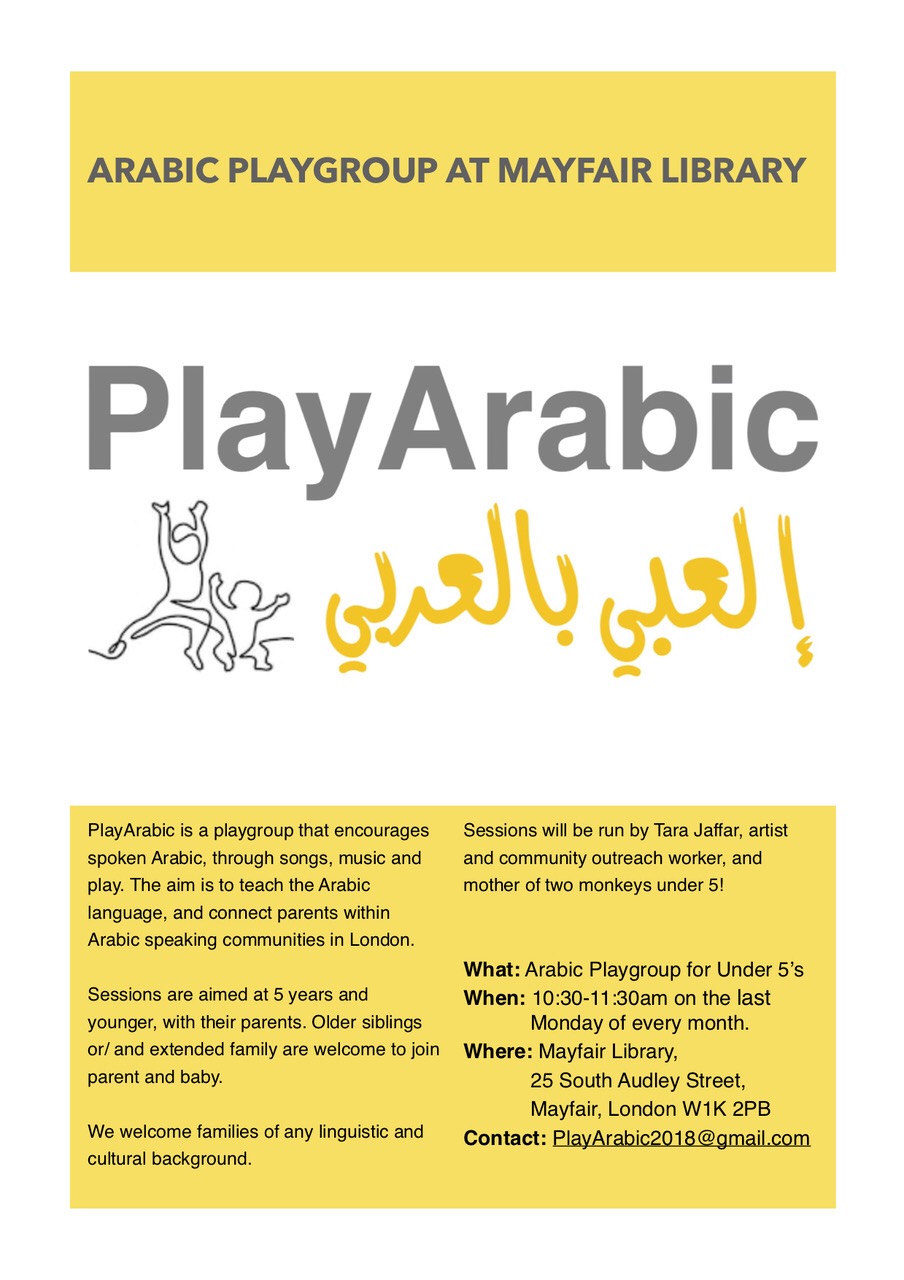
What to do if you can’t find an Arabic Playgroup in your area?
Start one!
What is PlayArabic?
This is a once monthly, parent-led initiative to keep our spoken Arabic language alive, creative and fun.
We will sing children’s songs, tell stories and play in Arabic.
The idea is to create a space immersed in spoken Arabic.
Dialects and differences
I’ve been asked whether this will be focused on Modern-Standard or dialect, and if the latter, whether I plan to use Egyptian, Levantine, Arab Gulf, North African etc. Well, I plan to do what I do with my two year old daughter, who I speak with exclusively in Arabic; I speak naturally in my own accent, but replace any specific Iraqi dialect words into modern-standard. For example, I don’t say خاشوگة or أوتي (khashoogha or Outti), I say ملعقة and مكوي (mal3aqa, makwi). So that when she hears and speaks with non-Iraqis, most importantly, her father’s family, she can understand and be understood.
Besides, rather than shying away from our dialectical (and cultural) differences, I’m planning to bring these to the fore. When we come across a word, like ‘hat’, which has a colourful array of variations in spoken Arabic, I hope we as parents can share these in the group. A way of acknowledging and even celebrating our differences.
Eventually, I’d love to do the same with nursery rhymes, as there are regionally specific ones too. This is another way of engaging and connecting diverse migrant cultures, in a similar line to what I’ve been doing for years in the community workshops I’ve organised and led.
The name
The Arabic name is a play on words, purposefully using the unconventional feminine verb, whilst assuming it applies to both female and male subjects. Usually, it’s the other way round, as was the position English language took before the advent of gender awareness, for example, Mankind.
Arabic has yet to have such a linguistic revolution, or at least, I’m ignorant of any that have already taken place.
Besides, in my experience, such groups are usually dominated by women, whether it’s mums, nannies, grannies etc., so why use the conventional masculine form to imply it’s for all?
And, fathers/ male guardians are more than welcome, of course!
Cantonese Inspiration
This group, including the English name, is inspired from a Cantonese Playgroup I came across, whilst looking for an Arabic equivalent. I’ve yet to find anything like this in Arabic for under 5 year olds, which I find shocking and sad.
I loved the story of the British-Chinese mother, who set-up the first group. She came to he UK from Hong Kong when she was eight, struggles with her own Cantonese, but found a way of passing on her mother tongue, as well as improving hers, through the Playgroup.
I also appreciate the openness of the group, as they are very organised, candid about how they set-up and run their multitude of groups, and share all on their website. A resource I’ve made full use of that with PlayArabic. I tried to make contact, to say Thank You and maybe pick their brains a bit, but not had any joy.
Support Networks
The next step would be to create a database of all Arabic children’s activities in London. Been searching for Under 5 groups in London since summer 2017, and hadn’t found anything. In my opinion, in our Middle Eastern/ Arabic culture, we lack the ability to create support networks, and tend to function in pockets of specific groups (I touch on this in a blogpost here).
Since organising PlayArabic, I’ve become aware of little music groups and informal classes and such that are not well advertised (or not made public at all!). Friends and friends of friends got in touch to share. Once I made contact, everyone has been warm and welcoming. It’s just hard to find that initial thread into such groups. Word-of-mouth is a powerful medium, and easily missed if you don’t have your ears pricked in the right direction. Could even be an App…if someone gets to this idea before me, even better, as my time is pretty tight with my own little ones.
The first play session will be at 10:30- 11:30am this Monday 29th October 2018 at Mayfair Library.
Yella, yella!
Spread the word, turn on your singing voices, limber up to act out stories within stories for the next generation!
However, when I fell pregnant with my first baby, my partner requested that, if it’s a boy, we name him after his own father (baby’s grandfather).
Our daughter was born and named, and when our son followed, I felt quite relaxed into his predestined name, which luckily I have always loved. Still, I feel we impose much of ourselves onto our children, and most of these we aren’t even aware of, that their name at least, I believed, should be unique to them.
Having spent the past month on my father-in-law’s farm, just outside of Amman in Jordan, I have had the chance to assimilate the meaning of this tradition.
Juggling two babies under two, alongside a move back to the UK, after some 7-months in the US, is a job in and of itself. And yet, since my daughter was born, I’ve found myself desperately clawing at life beyond motherhood. I wouldn’t describe myself as ambitious, in the superficial sense of the word, and before having my own family, had possessively kept my creative practice within a tight circle of peers. Yet, more recently, I’ve felt hungry to make something of myself,specifically, to create and share my artwork.
In February 2017, in the US, I wrote something to do with identity and belonging, inspired by events around the ‘Muslim Ban’. I organised two informal events, where I shared my work with invited audiences in October and November 2017. I was eight months pregnant with my second, as I sat on a high stool to read my text and sing Middle Eastern folk songs. The response was overwhelmingly encouraging. Since then, I rushed a 10-minute reading at AWAN festival 2018, recorded my first audiotape with Audible (involved a whole day at the studio), improvised live music for London Playback Theatre, and attempted (but failed) to hand in a funding application for 1st May. Oh, yes, and had a baby. Such processes would have been relatively minor blips in my life before babies, whereas now, a measly 10 minutes at a festival involved many hours of planning, coordinating and begging, mainly around childcare, which (frustratingly) didn’t include more than one informal rehearsal with the accompanying musician.
At the festival, I was not satisfied with what I shared, even when audience members came to share how the extract I shared resonated with them. I know I could have done better, and I know I rushed, and spent disproportionate amounts of energy on the stuff around the performance. Am also frustrated that I couldn’t attend anyone else’s talk/ play/ gig (major factor of my wanting to do the fest in the first place!), as I needed to rush home to my toddler- my infant came along, where he was attended to on site by two generous friends- so is the effort worth the end result?
I’m propelled, frustrated and curious as to where this ambition has come from; why am I pushing myself?
Limited free time often means I need to choose between a shower, food or working on text/ song/ funding app etc. This of course comes after my home work, as in homemaking work. That work doesn’t end, nor has any financial gain. Neither does my creative work, which makes it (logically) even more redundant. Funding would allow me to hire a studio, to arrange proper childcare, to physically leave the home, shelf my role of mum (as any working mother does) to invest in something that has deep meaning for me, as well as occasionally yielding some profit. Instead, I steal and dodge and tiptoe my way to editing a piece of writing, and fantasise about doing bodywork and perhaps reconnecting to the disembodied lump of meat I currently inhabit postpartum. In short, an indulgence. A guilty pleasure.
‘Why don’t you just pull out?’ a friend asked a few days before the festival. Not helpful. ‘You know you don’t have to do any of this, right?’ Again, this is not supportive.
My partner reminds me that I insisted on being a ‘full-time mother’, which is true. Though the idealistic person I was then, before actually having looked after little humans 24/7, is not the person I am today.
I partly chase my creative work in an attempt to work through, and integrate the major role of motherhood into my ‘self’, rather than allow it to become all that I am. The sum of the whole is greater than its parts, and all that jazz. Partly also, to escape the often isolating job of being mum. Isolating, and frankly, thankless. Being mum is an honour. Being a homemaker, I find, less so. At least for someone who is not naturally consistent, does not thrive on daily routines, and is absent minded (even before Baby Brains). Besides, the job of keeping a home are largely menial, unappreciated, and when down well, unnoticed.
So, even if I just manage an hour working on my laptop- usually in a cafe a few minutes from home- I take a moment, take some space, I might go into flow, I come back, physically more tired, but emotionally refreshed. Then, bath time becomes a delightful event, even breastfeeding, a welcome respite, and cooking, something I rarely enjoy these days, a little more of the hobby I once relished.
In short, I need it. I need my creative, artist self, otherwise, my life feels like a constant drain. I fail to see how much I have to be grateful for, when it intensely, and overwhelmingly encompasses each and every moment of my day (and interrupted nights).
Besides, I sincerely believe I am a better mother, when I am in touch with the creator in me. The maker. And I believe I’m doing something that one day will make my children proud.
***
I borrowed the title for this post from from Mothers who Make; a UK-based network aimed at supporting mothers who are artists, working in any discipline and at any stage of their careers.
We’re running some 15 minutes late, which I hate in general but especially when heading to the theatre. I tell myself, if we arrive and the show has started, then we can just go out for dinner instead. Walking into Chelsea Theatre, we approach a small desk, where some three assistants flick through papers looking for our reserved tickets. They don’t find anything. A woman writes down my name, and a man hurriedly ushers us in. We walk into a packed auditorium. I cannot see any empty spaces, except next to an elderly man a few rows from the front, who had placed his coat next to him, in an attempt to reserve the place. He sees me, politely clears the seat with a shrug of resignation. I look at my husband, then the usher, ‘we’ll find him a place, don’t worry!’ I apologise to the man as I sit in his friend’s seat, whilst watching to see where my husband will be squeezed in. They seat him at the end of a row on the other side of the auditorium, between a very young woman and another elderly man. Some half dozen people walk in after us, some argue and gesticulate until they manage to allocate themselves a makeshift seat, others are more embarrassed and accept the rejection, often after a wave and smile at familiar faces, watching from the safety of their seats. By now, the show itself is nearly 45 minutes late in starting. The woman to my left informs me that it’s been this busy almost every night since the play’s run, and this is the last evening. I’m intrigued.
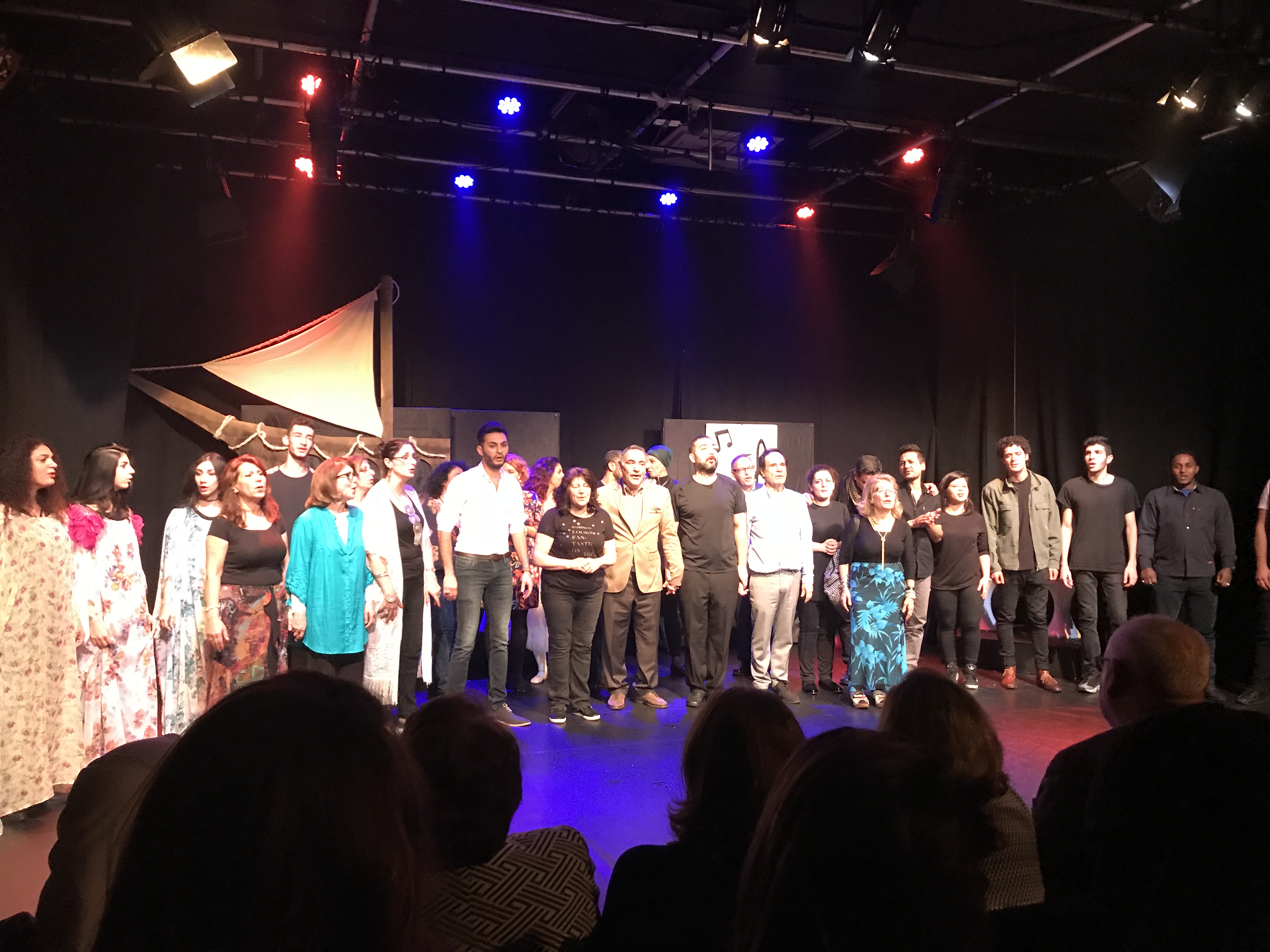
I am filled with the realisation that this is what community theatre is about; this reflection of life on stage, this interaction of audience members to what they witness, the meeting of friends and neighbors in the auditorium, as well as new meetings between people who essentially belong to the same ‘community’. Of course I wish our efforts are more organised- why the obscene overbooking and the lack of a program? I am sad that I do not know who directed this, or the names of any of the actors, or the lyricist of the ditties- and I’m also guilty of being late and expecting to have a seat regardless. All these, I realise, are peripheral, when the essence of theatre was so beautifully demonstrated with an auditorium full of spectactors ready to go on a journey via the stage.
When I first became a mother, just over a year ago, I was asked if my life has since gained more meaning, which I wrote about here. I rejected the idea that my life before baby lacked meaning. Reflecting more deeply on this, for me, the meaning I believe I’ve gained has a lot to do with how my child has become the nucleus of my entire life.
In the past, I pondered my choices and actions, and wondered how life would have turned out had I done this instead of that, or accepted this offer instead of that. I still ponder, though today, the possibility of altering the direction of my life, and risking alternative routes that may divert from my present is too distressing a possibility to linger on. Distressing because I would not dare risk anything that may delete my child’s presence in my life right now.
Yes, I could have done this, and was idiotic to reject that, and still, today, with my baby having her morning nap as I write, I dare not risk altering the course of history lest it leads me away from this gift in my life. A gift, until I had her, had no wish for.
I believe in fate, though I hope not in a fatalistic way. I follow the Arabic expression: use your mind, then rely on God. Namely, make plans and endeavor to execute them, and ultimately, your life is always in God’s hands. My grandfather quoted this, and lived by it, and he was a very ambitious and goal oriented person, and yet, was able to accept when life didn’t quite go to his particular plan. And as an Iraqi, his life certainly didn’t go to plan, as the country went from revolution to war to sanctions to whatever state it’s in today! He found meaning, and so the sensical wasn’t always in question.
I consider all those in the world who are suffering right now. From wars to natural disasters, cancer to bereavement; how to make sense of all this in the context of faith? Maybe we choose to accept because if we struggle to make sense of what life hands us, our alternative is to make meaning instead.
 starakin